Search This Blog

Translate

Wednesday, May 21, 2014

To be an eye-opener

Idiom: "to be an eye-opener"

Example: 

Darryl and John are talking...

Darryl: Did you know that the average household in California uses more than 350 gallons of water a day? That's over 1325 liters everyday! 

John: Each house?! That's a real eye-opener!


Meaning: An eye-opener is a shocking or surprising piece of news. It's something unexpected that makes you think differently about a situation or about the world.

For more information, please visit: www.languagesystems.edu

Thursday, May 15, 2014

To scorch & to roast

Idiom: to scorch & to roast; used as a verb


Example:
Carla: I just saw the news, and  it's going to be 97 today! I don't want to leave our air conditioned house.
Ken: I know! I went outside to take out the trash, and the sun was scorching!      
Carla: I'm not going to the movie.
Ken:  Fine by me; let's see if we can find something to watch on TV.

Meaning: Literally, "scorch" means to burn the exterior of something so that it is burnt or charred (for example, a blackened piece of chicken that is charred on the outside).  However, an American will sometimes say that the weather is "scorching," meaning that it is very hot. The idiomatic meaning of "scorch" suggests a person getting burnt by the sun, but it doesn't literally mean that the sun will blacken the person's skin. In the example above, Ken uses the idiomatic meaning of "scorch" to emphasize how hot the sun is - not that he actually got his skin burnt. Alternatively, there is another word with a similar idiomatic meaning, as seen below:

Ken: Why did you go outside? You know how hot it is.
Carla: I know, but I left my purse in my car yesterday! Unfortunately it was too late.  It was roasting in there, and my makeup was all ruined!                                       
Ken: Oh no! Was there a lot of makeup?
Carla:  Fortunately, I had only taken a few things with me last night, but it melted my favorite lipstick.
Ken: That's too bad - sorry to hear that.

Meaning: In this case, Carla uses the word "roast," which is usually used in cooking (for example, a roasted turkey) to idiomatically explain how hot it was in her car.  Since roasting is used for an enclosed heat, the idiomatic meaning is most often used when something is hot because it is closed up (for example, Carla's car), but it isn't limited to that use, and a sunbather who sits out in the sun for too long and burns his/her skin can be said to have roasted him/herself.

This week, we have been covering American idioms related to heat due to the high temperatures in Los Angeles. 

For more information, please visit: www.languagesystems.edu

Tuesday, May 13, 2014

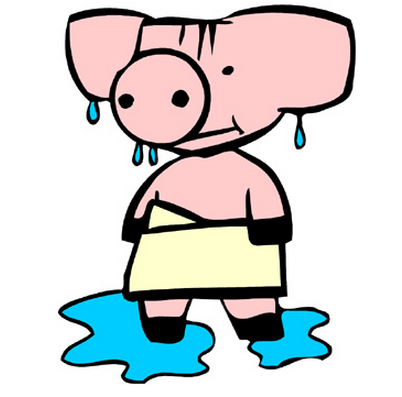
To sweat buckets & to sweat like a pig


Idiom: to sweat buckets & to sweat like a pig; used as verbs


Example:

Harry: Wow, it's hot out!
Jen: I know! I had to move some furniture, and by the end, I was sweating buckets!       
Harry: Do you need help?
Jen:  No.  We got everything moved.  But the next time I decide to rearrange my living room, I'm waiting until the winter.


Meaning: When an American says that someone is "sweating buckets," it means that the person is sweating excessively, either from physical movement or nervousness. The idiom suggests a person sweating so much that s/he is filling up buckets. In the example above, Jen uses the idiom to emphasize how much she was sweating after moving furniture - not that she actually collected her sweat in buckets.  Alternatively, there is another idiom with the same meaning, as seen below:

Jen: Wow, it's hot out!
Harry: Yeah it is! I went hiking yesterday, and I was sweating like a pig!
Jen: Was it a nice hike?
Harry:  Not really.  It was so hot, I didn't really enjoy myself.


Meaning: In this case, Harry uses the idiom "sweat like a pig" to tell Jen that he was also sweating excessively.  Ironically, pigs don't really sweat much, and they roll around in mud in order to stay cool, so this idiom doesn't make a lot of sense.

This week, we are covering American idioms related to heat due to the high temperatures in Los Angeles this week. 

For more information, please visit: www.languagesystems.edu

Thursday, May 8, 2014

To Burn (Oneself) Out


Idiom: “to burn (oneself) out”

Meaning:  To become tired, exhausted and/or lose interest from doing something too much.


Example #1:

Charlie: I’m so tired.  I can’t think anymore.  Studying everyday is making me crazy.

Sarah: Sounds like you burned yourself out Charlie.  Do you ever take breaks or time off from school?

Charlie: No, not really.  I study everyday for about six hours.  I study two hours after breakfast, lunch, and dinner. I never take a break.  This schedule feels like it will last forever.  I don’t know how much longer I can take this.

Sarah:  Wow! That’s too much.  You’re definitely burning yourself out.  You should consider some recreational activity during the day, to help you relax and focus on something else.  Otherwise, you will lose interest in studying.

Example #2:  
                         
Lauren:  I’m thinking about quitting the team.

Peter: Why?  I thought you loved soccer.

Lauren:  I burned myself out.  I practice three hours a day.  On Saturdays, I always play two games.  My only rest day is Sunday.  By the time I get home, I can’t study because I’m exhausted.  My performance in school is going down and my parents aren’t happy about that. 

Peter: Maybe, you should take a break or train less.

Meaning: “Burn (oneself) out” means to become tired, exhausted, or to lose interest from doing something too much. In example 1, Charlie is so tired from studying, that he can’t think anymore.  In example 2, Lauren is so tired from training that she is falling behind on her school work. 


For more information, please visit: www.languagesystems.edu

Tuesday, May 6, 2014

To Get Worked Up

Idiom: “to get worked up”

Meaning: To become worried or angry about something; to build up feelings of anticipation or anxiety about a situation, causing stress or strong emotions.


Example #1:

Superman: The day is so short and I can’t rescue everyone.

Louis: Don’t get so worked up about it.  You’re only one superhero.

Superman: I know, but everyone expects me to be super and to protect the world.

Louis:  That’s not a reason to become so upset.  It’s too much pressure for one person.

Example #2:  
                         
Leslie:  My favorite basketball team is losing the game.

Hanna: You’re getting worked up just talking about it.  Maybe you shouldn’t take sports so seriously.

Leslie:  I grew up watching the team with my dad.   We never miss a game.  We were so excited that they made it to the championship match this year. 

Hanna:  I understand, but it seems you’re really angry just thinking about the score.  Remember, it’s just a game.

Leslie: You’re right.


Meaning: “To get worked up” means to become worried or upset about something. In example 1, Superman is so worked up about not being able to save anyone that he forgets he is just one superhero.  In example 2, Leslie is worked up about her team losing and forgets about enjoying sports.


For more information, please visit: www.languagesystems.edu


Thursday, May 1, 2014

To Be Swamped

Idiom: “to be swamped”

Meaning:  To be overwhelmed with a great amount of work or obligations


Example #1:

Jackie: I’m so tired! I think I’ve been up for about 48 hours.

Johnny:  Oh, no. Why haven’t you been sleeping?

Jackie: I am absolutely swamped with work! I’m even taking it home at night and working on it. It just never seems to end!

Johnny:  Well, even though you are swamped, you still need to make time to take care of yourself and get some sleep.

Example #2:  
                         
Sarah: This is really irritating. Pete won’t even return any or my calls or texts.

Jacob: Didn’t you hear? He is swamped with family obligations right now. He has to take care of his sick grandma and his 7 year old niece is living with him, so he has to drive her to school every day.  On top of that, he works full-time. 

Sarah: Well, he could at least send me a text saying he can’t talk right now because he is swamped. It’s really rude to just not answer at all.  I thought he didn’t want to be friends anymore.

Jacob: No, he just has a lot of things to do. You should be more understanding and try to be supportive during this time. He’ll call eventually.

Sarah: You’re right.

Meaning: “To be swamped” means to be overwhelmed with work, studies, or obligations. In example 1, Jackie is so swamped with work she cannot even sleep at night.  In example 2, Pete is swamped with family obligations and cannot return any calls.  

For more information, please visit: www.languagesystems.edu 

Tuesday, April 29, 2014

To Be Floored

Idiom: “to be floored”
Meaning:  To shocked, surprised, or overwhelmed by something


Example #1:

Jenny: Hey, Johnny! Did you hear that Jane and Craig are getting a divorced?

Johnny:  No, I haven't heard that.

Jenny: Yes, apparently Craig found out that Jane has been having an affair with the next door neighbor! I was absolutely floored when I found out. They seemed like the perfect couple.

Johnny:  Well, I’m never floored by that kind of news. It’s just human nature.


Example #2:

Sarah: Guess what? Timmy won the lottery! I was just floored when I heard the news.

Jacob: Wow! That’s great. How much did he win?

Sarah: I think over a million dollars.

Jacob: I bet he was floored when he found out.

                            Sarah: Yes, he was. I think he still can’t believe it.

Meaning: “To be floored” means to be really shocked is floored by the news. In example 1, two people who seemed like the perfect couple are getting a divorce because of an affair.  Jenny cannot believe it and she is really shocked. In example 2, the two people are talking about their friend who won the lottery, which is very unusual and surprising.

For more information, please visit: www.languagesystems.edu